
From Castaic to Couture: The Legacy of Anita Ruby Jenkins Kellogg
In a crowd shot of flappers and party girls of the Roaring Twenties, chances are some of the hats you see were created by Castaic pioneer and fashion designer Anita Ruby Jenkins Kellogg.
Nowadays, hats are more often seen around Kentucky Derby days, when headgear competes with thoroughbreds for attention. Thanks to her infamous father, Kellogg has one degree of separation between her chosen art and a famous racetrack.
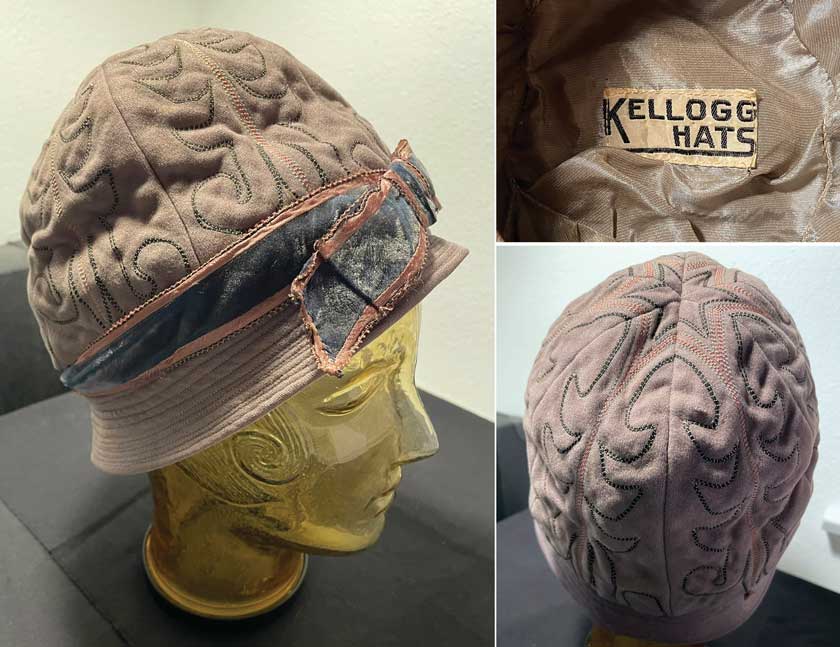
Kellogg designed a wide variety of women’s hats, including the cloche pictured here, that were popular and sold across the U.S. and Canada under the brand name “Kellogg’s Hats.” In 1927, her millinery empire employed 160 people who worked in the burgeoning fashion district of downtown Los Angeles.
Recently, the SCV Historical Society added one of her hats (which are very scarce today) to its collection and it will most likely be on display as part of a rotating exhibit in one of the museums currently being developed at the Santa Clarita History Center.
Born in Castaic in 1889, Ruby, as she preferred to be called, was the oldest daughter of William W. Jenkins. Jenkins was an 1850s vigilante and 1870s landowner who laid claim to both the island of Alcatraz in San Francisco and a sprawling ranch in Castaic, earning him the title of “The Baron of Alcatraz and Casteca.” He served as Justice of the Peace in Newhall for a short while and was a party in the infamous Castaic range war of 1890.
He ran with the movers and shakers of the time, notably Collis Huntington, John C. Fremont, California Governor Henry T. Gage, Cyrus Lyon and Elias J. “Lucky” Baldwin, who hired Jenkins to train his horses and named his Santa Anita racetrack after Ruby. She and her sister, June Jenkins Owens Kinler, were excellent horsewomen, well-known and popular.
Ruby married rancher Charles Kellogg and the couple made their home in Saugus, within the triangle formed by Bouquet Canyon Road, Magic Mountain Parkway, and Valencia Boulevard. The Kelloggs, even though they had no children of their own, donated a portion of their property to the school district for the expansion of the Saugus Elementary School that occurred in the late 1930s. The couple moved to a home on Apple Street in Newhall, where they hosted lavish parties.
William W. Jenkins, who had been shot at least seven times during his glory days, passed away from a cerebral aneurism on October 19, 1916. Ruby inherited the Jenkins Ranch in Castaic, and according to the late historian Jerry Reynolds, two oil wells came in on the ranch on March 1, 1952. It was a million-in-one shot that made national headlines.
Ruby’s last public appearance was in 1977, when Mentryville was dedicated as a California State Historical Landmark. At the gathering, she presented a paper bearing evidence that her father, with Sanford Lyons and H.C. Wiley, drilled the first well in Pico Canyon. Ruby passed away in 1979.
Comments
ADVERTISE WITH US
A Weekend Escape to Allegretto Vineyard Resort: Paso Robles’ Tuscan Dream
Just a two-and-a-half hour drive from Santa Clarita lies a little slice of Tuscany in Paso Robles — the 20-acre hideaway of Allegretto Vineyard Resort. Moe and I recently spent a delightful weekend there that felt like stepping into a painting: lush vineyards, olive...
It Takes A Village – Or A “Court” – To Preserve Our History
Among the collection of historic buildings at the Santa Clarita History Center are two former family homes - the 1878 Kingsburry House, moved to the Center in 1987, and the 1929 Edison House, moved to the Center in 1989. When these buildings arrived, three groups of...

NEVE A 25-Year Celebration of Timeless Alternative Rock
As we journey back to the year 2000, there’s one band that captured the spirit of the era with unforgettable melodies, powerful lyrics, and a sound that still resonates today—NEVE. Known for their emotional depth and raw energy, NEVE’s music helped define a moment in...