
Keeping Track of the Rolling Stock
They say that once you work on trains, railroading gets into your blood, and you never completely leave the tracks. Mike Jarel, a former locomotive engineer who worked for Southern Pacific and Union Pacific Railroad for 40 years and volunteer at the Santa Clarita History Center in William S. Hart Park, is a good example. Jarel moved to the Santa Clarita Valley in 1997 and got active with the SCV Historical Society in 2000.
“I came over when (former site coordinator) Pat Saletore asked me to look through some stuff that was in the yard and verify that it was railroad equipment, so they wouldn’t get rid of anything valuable,” he explained. “I came over and poked through the dirt and weeds and found some very rare and important items.”
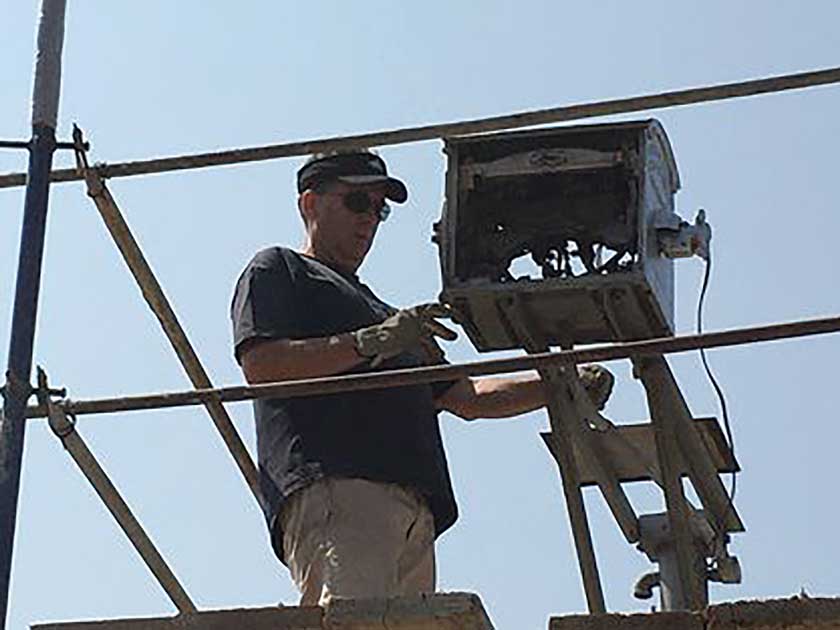
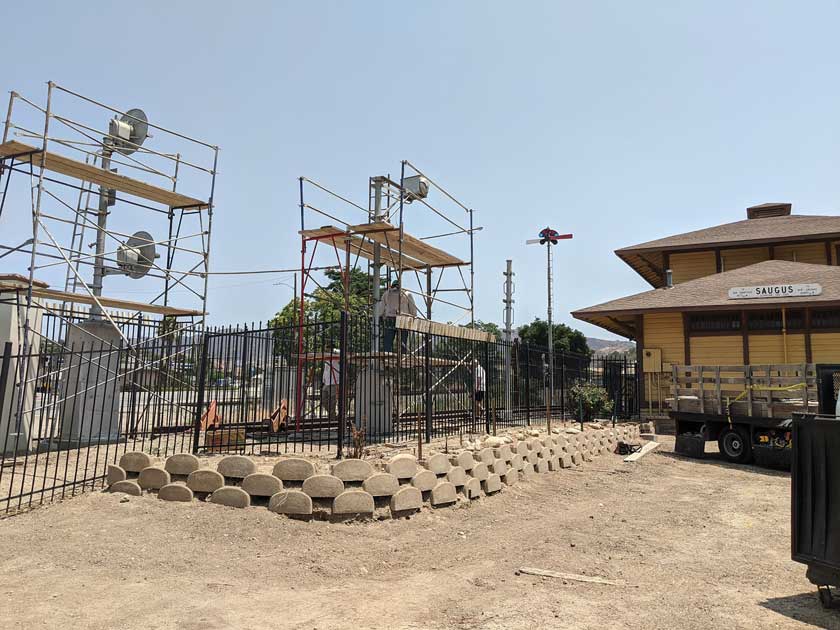
One thing he found was a semaphore, an apparatus with lights and colored arms that can be configured to convey messages from a distance, such as for approaching trains. It was broken down and in desperate need of repair. Jarel made sure all the parts were there and oversaw the restoration and reinstallation of the signaling equipment next to the depot.
His volunteerism has kept him busy for more than two decades, working on the rolling stock that includes the 123-year old Mogul No. 1629 steam-powered locomotive, a Southern Pacific caboose and related track equipment that sits on a siding next to the Saugus Train Station.
“In the beginning of my career, I actually interacted with the Saugus depot when it was still an active agency.” He also worked on one of the last trains to travel the Saugus route before the Southern Pacific merged with Union Pacific in 1996.
Once retired, he gave a talk at a Historical Society gathering about the history of the station, and he was hooked. He got involved with helping turn the Saugus depot into a museum, refurbishing, calling railroad connections and a network of experts to get tips and information on things like paint colors, architectural styles and even artifacts that have recently found their way to the depot.
Jarel said it’s important to develop an accurate railroad restoration so visitors and future generations can learn from it. “We need to make it look like a working depot.”
A team from Dave Davis Plastering came through with scaffolding for Jarel to reach the top of the signaling equipment, and Jarel has supervised some of the restoration work currently underway inside the depot. The goal is to bring it back to what it looked like in 1954 when the working depot took a star turn in the Frank Sinatra movie “Suddenly.”
Visitors to the park can walk around the outside of the depot and the other structures in the park. For more information on the developing museums at the Santa Clarita History Center, visit www.scvhs.org.
SCVHistory-May-June-P3

SCVHistory-May-June-P2
SCVHistory-May-June-P1
Comments
ADVERTISE WITH US
Valencia Auto Center: Part of the Neighborhood, Part of the Community
In Santa Clarita, neighborhood means more than geography. It is about connection, shared experiences, and showing up for one another. For nearly three decades, the Valencia Auto Center has been proud to be part of that fabric, not just as a destination for...

Unearth a Story: A Prehistoric Summer of Reading Awaits
This summer, the Santa Clarita Public Library is inviting the community to step back in time (way back) to a world of discovery, imagination and adventure. From Monday, June 8, through Friday, July 24, readers of all ages can take part in the annual Summer Reading...
Valencia Acura Earns Acura Precision Team Award for the 19th Time
Valencia Acura has once again earned the Acura Precision Team Award for 2025, marking the 19th time the dealership has received this prestigious national recognition. The award honors Acura dealerships that demonstrate outstanding performance in sales, service,...