
Sake 101: What You May Not Know About Sake
Are you a wine, beer or spirits lover? Any of those three are a gateway into Sake, a Japanese alcoholic beverage that has similarities to all three. Today I’m sharing what I learned at my Level 1 Sake class awarded by Wine and Spirits Education Trust (WSET):
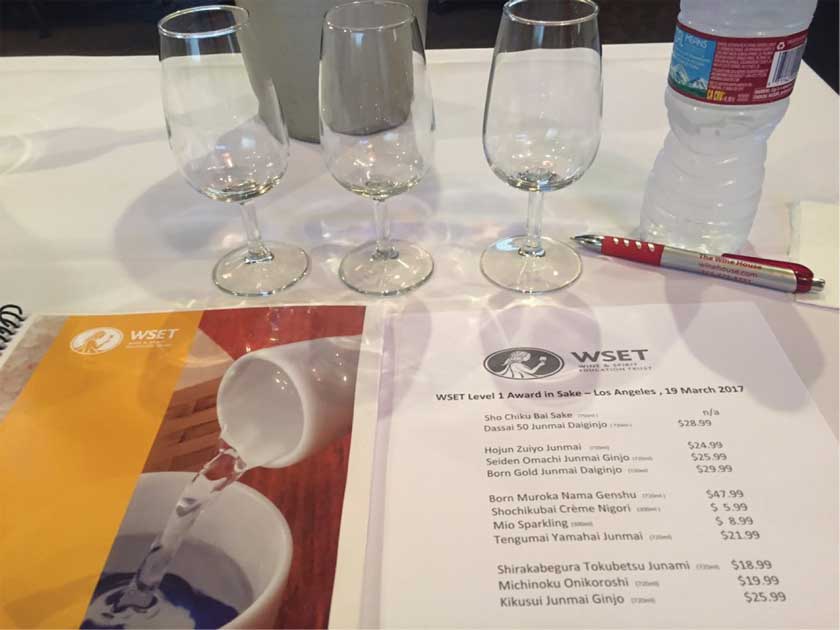
A small wine glass is “ideal for serving premium sake…tulip shaped to enhance aromas.” Well, that just about made my day right there. Those cute little cedar boxes called “Masu” are not ideal as the wood could impart flavor to the sake.
The word sake, Nihon-Shu in Japanese, just means an alcoholic beverage. Our teacher Toshio Ueno explained that if you travel to Japan and are asked out for sake, be prepared as it could mean anything!
Any kind of clean water can be used to make sake; however, harder water (like we have in LA) will produce a crisper, drier, richer sake while softer water produces a softer sake.
Just like baking bread, there is a fermentation starter of rice, koji (mold), water and yeast that goes into the main fermentation where the balance of the mixture is added.
The alcohol level of most sake is between 15% and 17% but may have started out at about 20%; water is added before bottling to lower the alcohol percentage.
There are two basic styles of sake that produce different aromas and flavors. Sake with more acidity, umami (savory), cereal and lactic – the brewer has polished away only some of the middle layers of the rice. Sake with flavors that are more floral and fruity, with less umami and acid – the brewer has polished away a higher ratio of the rice.
Sake rice and table rice are not the same. Table rice has more starch, and sake rice has a starch core, also known as a “white heart.”
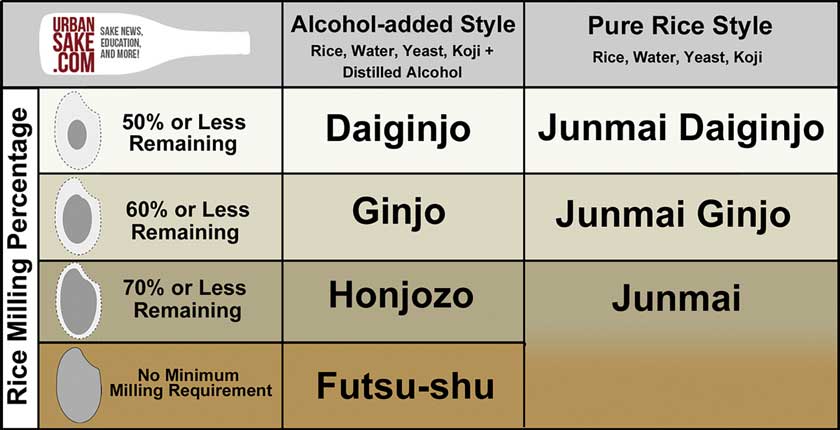
If the term “Junmai” is on the label, or even just part of the terms on the label, no alcohol has been added. Other popular sake – daiginjo, ginjo and honjozo – have alcohol. (To further explain, I found this via Google: The addition of distilled alcohol is one element that distinguishes sake varieties. Unlike Junmai, which is made using water, rice and koji alone, Honjozo, Ginjo and Daiginjo styles all contain the addition of “brewer’s” alcohol.)
Like wine, sake should be kept cool, may remain fresh for a couple of weeks in the refrigerator, can oxidize if open for too long and bright light should be avoided. Unlike wine, sake should be stored standing upright (the screw cap can rust!), be drunk young and kept refrigerated.
If you are warming sake use a warm water bath (thermometer should read 176 Fahrenheit) instead of your microwave to control the heat. Sake labeled Futsu-shu, junmai and honjozo can be served both cold and warm.
Tokkuri is the name of the sake carafe and the traditional cups are called o-choko.
Why are the cups so small? Because refilling them frequently is a “tradition of Japanese hospitality.”
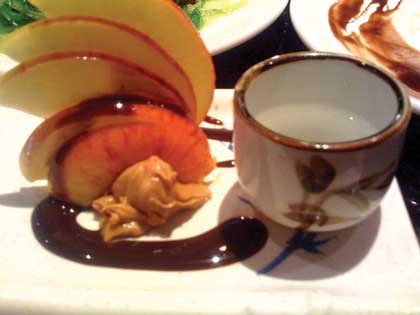
Pairing sake and food doesn’t just begin and end with Japanese fare like sushi or sashimi. Just like with wine pairing, go with foods that have a similar taste profile, i.e. sweet with sweet and savory with savory.
In a Sake seminar with Toshio Ueno and fellow educator Niikawa-Helton – an expert in warm sake – I learned that just like seasonal cocktails, Japanese people drink their sake warm in the winter and cold in the summer. Warmed sake can make sweetness, bitterness and/or acidity more prominent. Heating sake is also a form of hospitality, obviously showing your guest that you care about their comfort.
What was even more interesting to me were two side-by-side sake tastings: one warm and one cold. After noting the aromas and flavors in both, and finding them starkly different, I declared, “Oh, these are two different sakes” only to find out I was dead wrong.
Wow. Sake epiphany! The same sake tasted completely different warm than it did cold! For me the cold sake had more floral and sweet notes, while the hot had more savory and umami (thinks soy sauce, mushroom) characteristics.
Niikawa-Helton said that warm sake pairs extremely well with thinly sliced prosciutto and cheeses like Gruyere, Romano and Pecorino – something I can’t wait to try with guests!
A note on heating sake: both Ueno and Niikawa-Helton recommended immersing the sake vessel (usually a porcelain carafe made to withstand heat) into hot water – never use a microwave. If seems too hot you should just “add more sake!”
Eve Bushman has a Level Two Intermediate Certification from the Wine and Spirits Education Trust (WSET), a “certification in the first globally-recognized course” as an American Wine Specialist ® from the North American Sommelier Association (NASA), Level 1 Sake Award from WSET, was the subject of a 60-minute Wine Immersion video (over 16k views), authored “Wine Etiquette for Everyone” and has served as a judge for the Proof Awards, Cellarmasters, LA Wine Competition, Long Beach Grand Cru and the Global Wine Awards. You can email Eve@EveWine101.com to ask a question about wine or spirits.
EveWine-Sake101-P1
EveWine-Sake101-P2
EveWine-Sake101-P3
EveWine-Sake101-P4
Comments
ADVERTISE WITH US

A Message from the Associate Publisher Alexander Hafizi – May/June 2026
There are moments in life that truly make you pause, reflect, and feel an overwhelming sense of gratitude. Being nominated for SCV Man of the Year is one of those moments for me.To be recognized is an honor in itself, but to be nominated by three incredible...

A Life of Purpose Dr. Robert “Jack” Casey and the Heart of Emergency Medicine
In every community, there are individuals whose work quietly shapes the lives of others in profound and lasting ways. In Santa Clarita, one of those individuals is Dr. Robert “Jack” Casey, a physician and leader whose impact reaches far beyond the walls of Henry Mayo...

A Life Built on Connection, Creativity, and Community Featuring Mario Brucker
For SCV Senior Center member Mario Brucker, life has been a journey defined by resilience, creativity, and the power of human connection. Having been part of the center for nearly three years, Mario has found not just a place to spend his days, but a true sense of...