
Surrounded by history? Yes, you are!
All of the history in our valley isn’t contained in the Santa Clarita History Center – every way you turn, you can find a place that changed the course of our community – even the state! Let’s go explore:
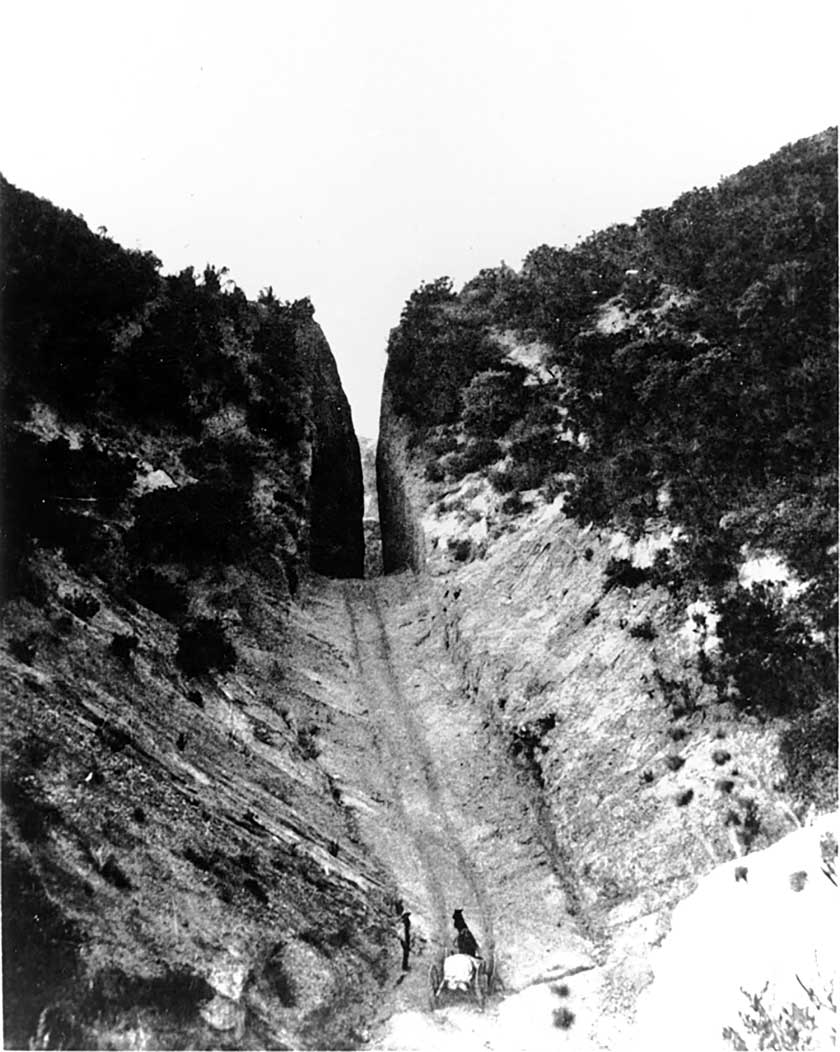
Beale’s Cut was created in 1862 by troops working with just picks and shovels, under the direction of Gen. Edward F. Beale, and cut a path through the San Gabriel and Santa Susana Mountain ranges. Along with being a toll road, it was also a popular film location. Sadly, nature is taking back the hill and a large portion of the cut has collapsed on itself. It’s located off Sierra Highway near Clampitt Road in Newhall.
Next, we’re betting you’ve been to the Lyons Station Stagecoach Stop, which is now Eternal Valley Memorial Park. It was once the site of a combination store/post office/telegraph office/ tavern, and stage depot accommodating travelers during the 49ers gold rush. A regular stop for the Butterfield stage line, it was purchased by Sanford and Cyrus Lyons in 1855, and by 1868, 20 families lived here. The Lyons brothers’ final resting place is now the Garden of the Pioneers at the memorial park, which is on Sierra Highway, near Hwy. 14 and Newhall Avenue, Newhall.
Francisco López made California’s first authenticated gold discovery at the Oak of the Golden Dream on March 9, 1842.. Cue the onslaught of placers and miners who brought pans, sluices and dry washing techniques to get the precious metal out of the canyon. You can visit by taking a gentle walk through Placerita Canyon State and County Park in Placerita Canyon.
One of the coolest historic sites that has recently been preserved is the Pioneer Oil Refinery in Newhall. In 1875 the Star Oil Company (which became Standard Oil Company of California) drilled its first Pico Canyon well, yielding about 100 barrels per day and in 1876, the first commercial oil refinery in California was built. The existing structures have been preserved as part of the Gates-King Industrial Park development and soon, visitors will be able to visit and learn about the influence of oil on our little town.
Every year, the SCV Historical Society conducts a tour of the ruins of the St. Francis Dam Disaster Site (sorry, this year’s tour is sold out!). In 1926, William Mulholland constructed a 185-foot concrete dam in San Francisquito Canyon. On March 12, 1928, just before midnight, it collapsed and sent over 12 billion gallons of water roaring down the Santa Clara River toward
Ventura, killing more than 450 people, stripping homesteads and farmlands and sending debris as far as the Pacific Ocean. Drive up San Francisquito Road about 9 miles and stop at Powerhouse 2 on the right side. Pass the powerhouse and start looking in the riverbed on the right, where you’ll most likely be walking on debris.
On September 5, 1876, Charles Crocker, President of the Southern Pacific Company, drove a gold spike at Lang Station in Canyon Country to complete his company’s San Joaquin Valley line, and complete the transcontinental connection of rails between Los Angeles and San Francisco. Over the years, stations closer to the urban area made Lang obsolete and it was demolished. The event is commemorated with an art installation at the Vista Canyon Metrolink station, located 10 miles south of the Lang Station original location. Take Soledad Canyon north to taking Lost Canyon and head east.
Visit www.scvhistory.com and learn more about these and more historic sites in the Santa Clarita Valley. We’ll do this again in the summer! Stop by our website, www.scvhs.org, and sign up for our monthly newsletter!
Comments
ADVERTISE WITH US

A Message from the Associate Publisher Alexander Hafizi – May/June 2026
There are moments in life that truly make you pause, reflect, and feel an overwhelming sense of gratitude. Being nominated for SCV Man of the Year is one of those moments for me.To be recognized is an honor in itself, but to be nominated by three incredible...
A Life of Purpose Dr. Robert “Jack” Casey and the Heart of Emergency Medicine
In every community, there are individuals whose work quietly shapes the lives of others in profound and lasting ways. In Santa Clarita, one of those individuals is Dr. Robert “Jack” Casey, a physician and leader whose impact reaches far beyond the walls of Henry Mayo...
A Life Built on Connection, Creativity, and Community Featuring Mario Brucker
For SCV Senior Center member Mario Brucker, life has been a journey defined by resilience, creativity, and the power of human connection. Having been part of the center for nearly three years, Mario has found not just a place to spend his days, but a true sense of...