
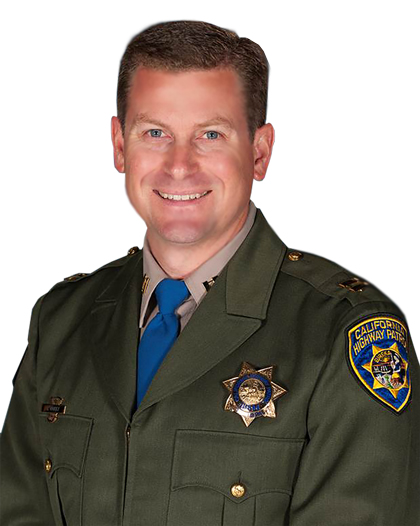

With an extensive background in communications, CHP Captain Edward Krusey is putting a renewed focus on connecting with the community, by sharing information and services with the public in a new format.
“We want to create a more open dialogue with the public by getting some of our social media accounts up and running,” Krusey said. “We also focus a lot on community service, and I’d like to expand some of those programs.”
A Santa Clarita resident for almost 30 years, Krusey has worked in the department for 20-plus years, doing stints all over the Los Angeles area. In July 2013, he was promoted to captain and became commander of the Los Angeles Communications Center, and in November 2014, he was transferred to the Newhall area. When he finally had the opportunity to work in the city where he lives, Krusey said it felt like coming home again.
Originally from Glendale, Krusey and his wife have called Santa Clarita home for about 30 years and feel it is the perfect place to raise their three children. During his tenure with the CHP, he has worked in the Bay Area, Central Valley and Los Angeles.
It seems a call to law enforcement has always been in his blood. “My father worked for the Los Angeles Police Department, “ Krusey said. “I started with the CHP as an Explorer. In 1995, after graduating the academy, I reported to the South LA area.”
As he climbed the ranks, Krusey wanted to grow his education alongside his experience in the field. As a CHP sergeant and lieutenant, he worked hard to earn a Bachelor’s Degree in sociology and a Master’s Degree in public administration.
“I was fortunate to go back to school,” Krusey said, “and the degrees were very beneficial.”
Supported by his education, Krusey was promoted to captain and was assigned to the position of commander of the Los Angeles Communication Center. In this role, Krusey was responsible for the day-to-day operations of the only CHP Communications Center in Los Angeles County, which incorporated the Transportation Management Center, Metro Express Lanes program, Freeway Service Patrol program, and Emergency Operations Center. LACC is the largest of the CHP’s 25 communications centers. In 2014, LACC handled almost 2.1 million calls for service, with almost 1.8 million of those calls being wireless 911 calls.
With only a few captain positions in the Southern California area, the mere position alone was an incredible honor and accomplishment, Krusey said. The fact that Krusey got to oversee operations in his hometown was just a bonus – a really big bonus. “(The position as commander) was a great opportunity,” Krusey said, “but this is home – this is where I want to be.”
As the commander of the Newhall station, Krusey has turned his focus to increasing meaningful communication with residents and providing more of the valuable services currently available to local families.
“The CHP was slow to embrace social media. Now we understand the benefits it can provide, as a way to reach and receive feedback from the public,” Krusey said. “Since reporting here, we’ve been making an effort to expand our social media, getting those accounts up and running. We want to be able to address the public in a meaningful way.”
In the coming months, CHP will be rolling out new social media accounts, as well as ramping up use and interaction on existing platforms, Krusey said. In addition to increased community awareness, Krusey aims to expand the department’s service programs, particularly the Explorers and Senior Volunteer programs.
“We have a lot of service-oriented programs,” Krusey said, “some of which the public isn’t always aware of. We are a law enforcement agency, and part of that is educating the public to put them in a safe position.”
CHP Safety Programs Available to the Public
Age Well Drive Smart: The Age Well Drive Smart program aims to reduce collisions, death, and injuries experienced by aging drivers, as well as to increase alternate transportation options when driving is no longer an option.
Child Safety Seat Install & Inspection: Residents may bring their child safety seat to their local CHP office for a free installation, inspection, or troubleshooting. Trained safety technicians, who have completed the appropriate schooling, will assist you.
Every 15 Minutes: This two-day drunk driving collision simulation occurs on all participating high school campuses. During this simulation, driving-age students witness a crash, death of their fellow classmates, and speeches by parents who have experienced the real loss of a loved one to drunk driving.
Explorers: The Explorers program gives young men and women, ages 15 to 21, the opportunity to develop the knowledge and skills needed to better serve their community and, later, start a career in law enforcement, if desired. By assisting CHP in the office and field, Explorers learn about the justice system as they gain necessary life skills. Explorers receive physical fitness, medical, organizational, and clerical training.
Impact Teen Drivers: This non-profit program brings teens together with their parents to learn the causes of collisions, focusing on the most deadly. Family members who have lost a loved one in a teen-related collision will speak to the audience. Information on the Graduated Driver License is also available.
Right Turn: For middle school students, the Right Turn program teaches children how to handle situations with a drunk driver, confrontations with peer pressure, and their first experiences with drugs and alcohol – before it happens.
Senior Volunteer Program: Senior volunteers assist the CHP in providing enhanced public service to the community. In addition to learning about the justice system, volunteers help out in a number of ways, including: clerical duties, deployment of radar trailers, directing traffic at events, and more.
Smart Start: Smart Start brings deputies and provisional drivers together to teach teens the rules of the road – before they get behind the wheel. Aimed at helping newly- licensed or soon-to-be drivers from ages 15 to 19, this discussion-based program covers collision avoidance techniques, excessive speed, DUI avoidance, and distracted driving.